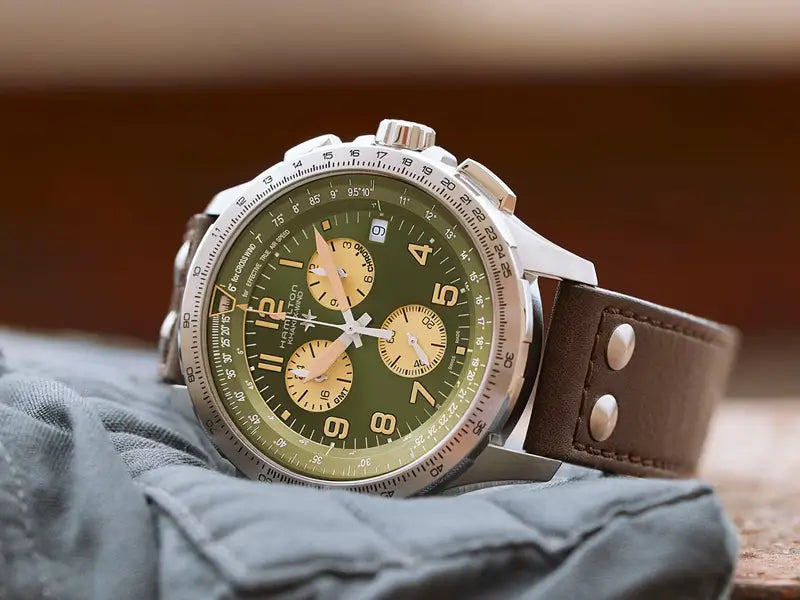
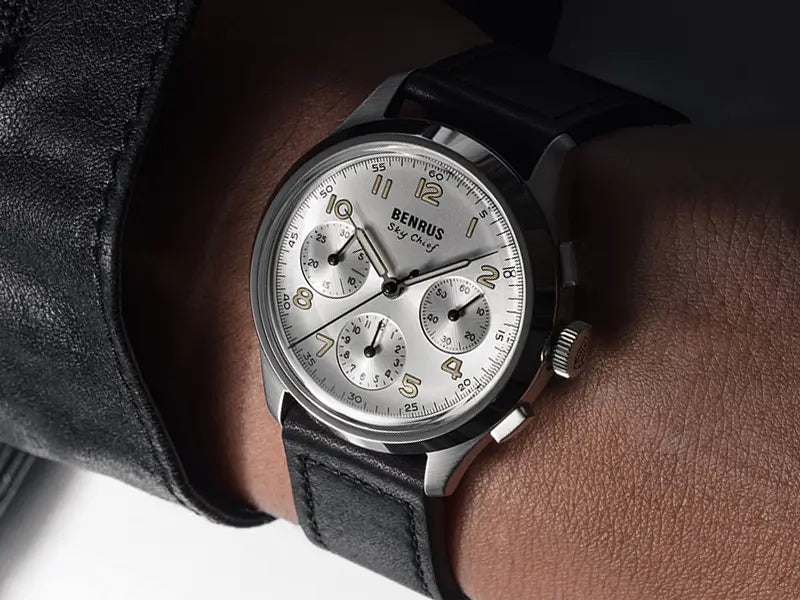
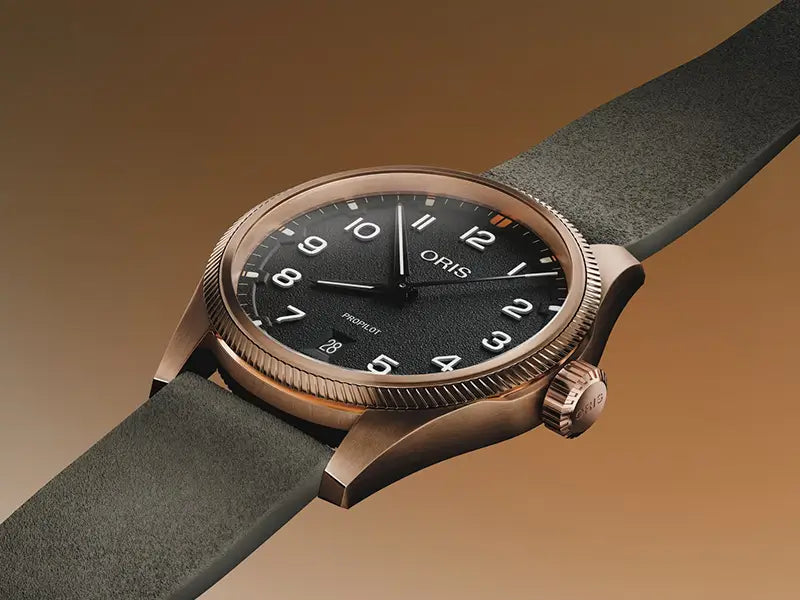
A pilot watch is a timepiece built for the cockpit, designed so a pilot can read the time instantly, even in poor light, turbulence, or while wearing gloves. Its signature features include a large, uncluttered dial with bold numerals and luminous hands, an oversized crown that is easy to grip, and often protection against magnetic interference from cockpit instruments. Some pilot watches add a second time zone or a chronograph, but the defining idea is clarity and dependability. Born in the early days of aviation, the pilot watch has become one of the most enduring and recognizable styles in watchmaking, equally at home in the cockpit or on the street.
History of Pilot Watches
The pilot watch begins with one of aviation’s first celebrities. In 1904, Brazilian aviator Alberto Santos-Dumont complained that fumbling for a pocket watch while flying was impractical, and his friend Louis Cartier responded with a wristwatch that could be read at a glance. The Cartier Santos is widely credited as one of the first purpose-built wristwatches for pilots, and it helped push the wristwatch from novelty toward necessity.
As aviation matured, navigation became the pilot’s central challenge, and watches evolved to meet it. In the early 1930s, Longines created watches with Navy Lieutenant Commander Philip Van Horn Weems and with Charles Lindbergh, using rotating bezels and minute scales that made celestial navigation easier. In 1940, Germany’s Luftwaffe standardized the large, high-contrast observation watch, known as the B-Uhr, produced by several makers including IWC and Lange. Its oversized dial, long strap to fit over a flight jacket, and soft iron protection against magnetism set the visual template that many pilot watches still follow. Around the same time, the British Royal Air Force adopted its own military-issue watches, including the legendary Mark 11, introduced in 1948 and made by IWC.
After the war, civil aviation brought a new wave of designs. In 1952, Breitling launched the Navitimer, a chronograph with a built-in circular slide rule that let pilots calculate fuel, speed, and distance, and it was soon adopted by aviation associations. In 1954, Rolex introduced the GMT-Master, developed with Pan American Airways for its long-haul pilots, which added a second time zone hand for tracking home time across multiple time zones. As cockpit electronics and GPS took over primary navigation, the watch shifted from essential tool to trusted backup, and pilot watches found a new life as a classic, rugged style worn by pilots and non-pilots alike.
A pilot watch, also called an aviator watch or flieger watch, is a watch designed for use in the cockpit. It features a large, highly legible dial with bold numerals and luminous markings so the time can be read instantly in any lighting. Many also include an oversized crown, antimagnetic protection, and sometimes a second time zone or chronograph function.
What makes a watch a pilot watch?
There is no single rule, but most pilot watches share a common design: a clean, high-contrast dial with large Arabic numerals, bold luminous hands, an oversized crown for use with gloves, and a robust case. Many also feature an anti-reflective sapphire crystal, which reduces glare, and a movement protected against magnetism.
Why do pilot watches have large crowns?
Pilots historically wore gloves, especially in unheated cockpits, so a large, grippy crown made it possible to set and wind the watch without removing them. Many modern pilot watches keep the oversized crown, often with a textured or onion-shaped edge, as both a functional and a signature design detail.
What is a flieger or B-Uhr watch?
A flieger, or B-Uhr, is a German-style pilot watch based on the observation watches made for the Luftwaffe in the 1940s. It is known for its large, plain black dial with a triangle marker at twelve and oversized Arabic numerals. The look has since become a model for modern pilot watches.
Why are pilot watches antimagnetic?
Cockpit instruments and electronics generate magnetic fields that can disturb a mechanical watch's movement and affect its accuracy. Some pilot watches include a soft iron inner case that shields the movement from magnetism, which is one reason the feature became a hallmark of the category.
What is a GMT pilot watch?
A GMT pilot watch has an extra hour hand, usually with a 24-hour scale, that tracks a second time zone. It was developed so long-haul pilots could keep track of home time or a universal reference time while flying across zones. It is also popular with frequent travelers.
Is a pilot watch a chronograph?
Not necessarily. Many pilot watches are simple three-hand models focused on clarity, though some add a chronograph, a GMT, or a navigation slide rule. A pilot chronograph is a popular variation, but a pilot watch can be a chronograph or have no stopwatch function at all.
What is the difference between a pilot watch and a field watch?
Both prioritize legibility and durability, and they look similar at a glance. A field watch is a simple, rugged military-style watch designed for general use, while a pilot watch is tailored to aviation, with a larger dial, bolder markings, and features like an oversized crown, antimagnetic protection, and sometimes a second time zone.
Can I wear a pilot watch every day?
Yes. Pilot watches are built for legibility and durability, which also makes them excellent everyday watches. Their uncluttered dials and sturdy cases work well with casual and business-casual outfits, and many models come with a leather strap or a steel bracelet that can be swapped to suit the occasion.
Do pilots still wear pilot watches?
Yes, though the watch is now usually a backup. Modern cockpits rely on digital instruments and GPS for navigation and timing, but many pilots still wear a reliable, analog watch as a dependable secondary tool that doesn't rely on a battery-powered display.
Most watch lovers have worn a Schwarz Etienne movement without ever seeing the name on a dial. For more than a century, this small manufacture in La Chaux-de-Fonds has built calibers and components for other brands. Today it also signs its own watches, and almost every one of them is built around the same elegant idea: a small, off-center winding rotor tucked into the movement instead of a big one sweeping over it.In this spotlight we cover where Schwarz Etienne came from, what makes it a true independent manufacture, how a micro-rotor works compared with a full central rotor, and which in-house calibers and collections are worth knowing, from the Kari Voutilainen-finished Roma Synergy to the new 39mm titanium 1902...
NOMOS Glashütte has turned its Club Sport neomatik Worldtimer into the most collectible watch in its catalog, and 2026 has kept the limited editions coming. The latest is an Edition Handelsblatt with stock-exchange codes in orange, following the champagne-dialed Roam and Reverie (175 pieces each). Around them, NOMOS used Watches and Wonders 2026 to shrink its ring-date Tangente to a slimmer 38.5mm in steel and 18k gold, then launched Twice Unique, matched gold-and-steel pairs with hand-finished dials.Here is what is new, what it costs in the US, and which one deserves your attention.
A great strap can change a watch more than any other single upgrade, and few makers have built a following around that idea as quickly as Delugs. Founded in Singapore in 2018 by Kenneth Kuan and Chia Pei Qi, the brand began with leather straps crafted in a bedroom and now makes cut-to-size FKM rubber, Japanese shell cordovan, alligator and other exotics, watch-specific integrated straps, and its own steel and titanium clasps.This guide covers where Delugs came from, what each material is good at, how its made-to-order and bespoke programs work, how to choose the right lug width and length, and how to look after a strap so it lasts. We have also listed representative US prices from delugs.com.
New York studio Massena LAB has given Atelier Wen’s all-tantalum Inflection a solid gold heart. The 40mm Inflection Shuò pairs a hand-engraved 18K gold dial, mixing Arabic and Chinese numerals, with a customised Girard-Perregaux GP03300 automatic. Just 50 pieces, $44,100, deliveries from early 2027.Our first look at the collaboration, from the tremblage dial to the tantalum bracelet, plus how it compares with the standard Inflection and the Perception V3.