
Field Watches

Field Watches

Field Watches

Field Watches

Is an authorized Retailer for all brands
 featured in the Field Watches collection

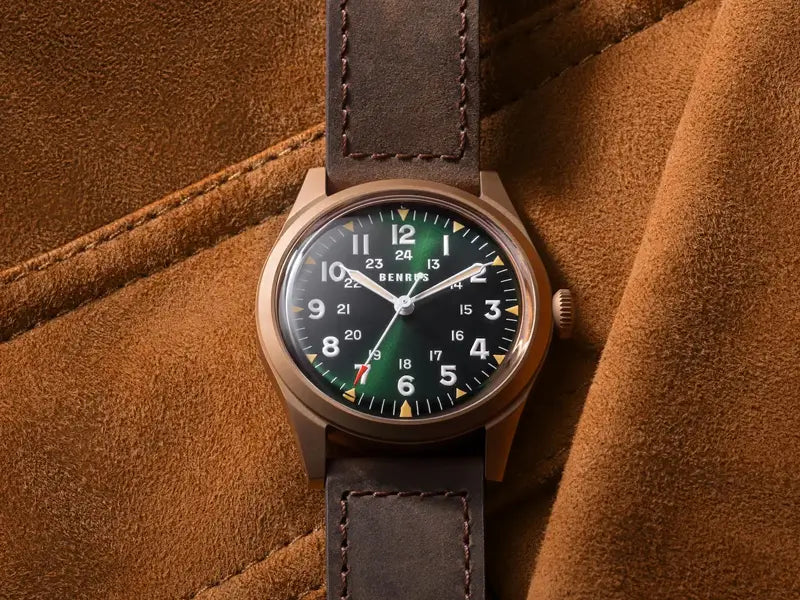
A field watch is a simple, rugged timepiece built for use in the field, whether that means a battlefield, a hiking trail, or a long day outdoors. Its defining traits are a clean, high-contrast dial with bold Arabic numerals, luminous hands, a durable case, and a no-nonsense layout that can be read at a glance in poor light. Born as military issue and refined over more than a century, the field watch has become one of the most popular everyday styles, prized for its legibility, toughness, and understated, utilitarian charm.

History of Field Watches

The field watch traces back to the trenches of the First World War. Soldiers found pocket watches impractical in combat, so makers adapted small pocket watches into wristwatches, fitted with wire lugs, protective crystal guards, and luminous dials. These “trench watches” proved that a watch worn on the wrist was a genuine tool, and they helped turn the wristwatch from a novelty into a standard.

The modern field watch took shape during the Second World War, when armed forces on every side wanted a reliable, inexpensive, easy-to-read watch that could survive harsh conditions. In Britain, the Ministry of Defence commissioned twelve Swiss makers to supply waterproof wristwatches for the military. Their case backs were stamped “W.W.W.,” short for “Watch, Wrist, Waterproof,” along with the Broad Arrow, a mark of government property. These watches, now collected as the “Dirty Dozen,” shared a plain black dial, luminous hands, and a small seconds subdial, and they set the pattern for the field watch’s look.

In the United States, military specifications for field watches evolved after the war. In 1964, the U.S. government published MIL-W-46374, calling for an accurate, durable, and essentially disposable watch for ground troops, while a separate specification covered watches for aviators. Makers like Hamilton produced these watches in huge numbers, and they became closely associated with the Vietnam War era. When the military’s specifications changed in the 1980s, Hamilton brought the design to civilians, and the field watch moved from standard issue to a classic everyday watch. Today it is celebrated for the same qualities that made it essential in the field: clarity, toughness, and simplicity.

Field Watches FAQ

What is a field watch?

A field watch is a rugged, simple watch designed for use outdoors and in the field, originally developed for military personnel. It typically has a clear, high-contrast dial with bold Arabic numerals, luminous hands, and a durable case, so the time is easy to read at a glance in any light. Many models are small and slim enough to wear comfortably all day.

What makes a watch a field watch?

There is no single rule, but most field watches share a common design: a matte, uncluttered dial in black, white, or green, large Arabic numerals, a sturdy case, and a simple strap. Many also include a 24-hour scale for military time, and some add a date window. The overall look is utilitarian and understated, with function taking priority over decoration.

What is the difference between a field watch and a pilot watch?

Both prioritize legibility and durability and can look similar at first glance. A field watch is a general-purpose military-style watch, usually compact and simple, while a pilot watch is tailored to aviation, often with a larger dial, an oversized crown for gloved hands, and sometimes antimagnetic protection or a second time zone.

What is the difference between a field watch and a dive watch?

A dive watch is built for use underwater, with a high level of water resistance and a rotating bezel for timing a dive. A field watch is built for general rugged use on land, so it usually has a simpler case and no rotating bezel. Many field watches offer moderate water resistance, but they are not intended for diving.

Why do field watches have a 24-hour scale?

Military personnel use 24-hour time to avoid confusion between morning and evening. Many military-issue field watches added a second ring of numbers, often running from 13 to 24, to show military time alongside the standard 12-hour markers. Not every field watch has one, but it is a popular heritage detail.

Are field watches good for everyday wear?

Yes. Field watches are among the most versatile everyday watches. Their durable construction and clear dials work well at the office, on the weekend, or outdoors, and their understated look pairs easily with casual and business-casual outfits. They are a popular first mechanical watch for exactly this reason.

What is a trench watch?

A trench watch is an early wristwatch from the First World War, usually a small pocket watch adapted to be worn on the wrist with wire lugs, a luminous dial, and sometimes a protective cover over the crystal. Trench watches are considered ancestors of the modern field watch and helped make the wristwatch a standard tool for soldiers.

What is the best strap for a field watch?

Fabric NATO-style straps, canvas straps, and leather straps are the classic choices, since they reinforce the field watch's rugged, utilitarian look. A leather strap in brown or tan adds a vintage feel, while a steel bracelet gives a more polished, versatile style. Many field watches use standard strap widths, so they are easy to change to suit your outfit.

Should I choose an automatic, manual-wound, or quartz field watch?

Each option suits a different wearer. Manual-wound and automatic field watches offer traditional mechanical craftsmanship and appeal to collectors, with automatics winding themselves from wrist movement. Quartz field watches are highly accurate, low maintenance, and often lighter, making them a practical choice for anyone who wants a dependable grab-and-go watch.

Are field watches water resistant?

Most have at least some water resistance, enough to handle rain, splashes, and hand washing, but ratings vary widely between models. Check the rating on your specific watch before swimming, and have the seals checked regularly, especially after a battery change or any time the case is opened.