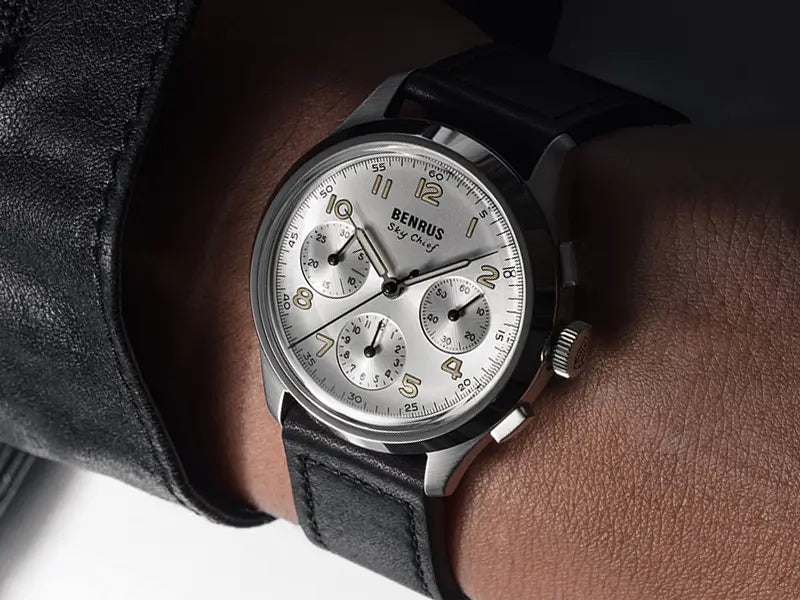
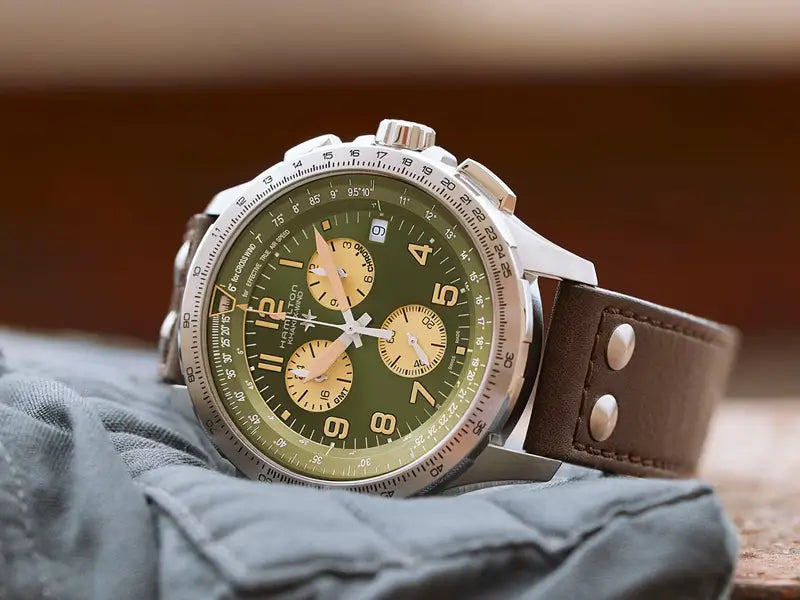
A chronograph watch is a timepiece with a built-in stopwatch, letting you start, stop, and reset an elapsed-time measurement with the push of a button while the watch keeps telling the regular time. Most chronographs show the timing function through a central seconds hand and small subdials that track minutes and hours, often with a tachymeter scale on the bezel for measuring speed. Born in racing, aviation, and military timing, the chronograph has become one of the most popular and recognizable complications in watchmaking, valued for its useful function and its distinctive, technical look.
History of Chronographs
The chronograph predates the wristwatch by more than a century. In 1816, French watchmaker Louis Moinet built a device to time astronomical events and is widely credited with the first chronograph. A few years later, in 1821, Nicolas Rieussec created a timer for King Louis XVIII that marked ink on a spinning dial to time horse races. Its name comes from the Greek words for “time” and “writing,” a literal description of how it worked, and the name stuck even after ink was dropped from the design.
Through the nineteenth century, chronographs lived mostly in pocket watches used by scientists, sportsmen, and the military. The wrist chronograph arrived in the early twentieth century, when Longines introduced a wristwatch chronograph in 1913, followed by further improvements from makers like Breitling, which added a separate pusher for starting and stopping the timer and later a second pusher for resetting it. Those pushers gave the chronograph the familiar two-button layout it still has today. Over the following decades, chronographs became essential tools for pilots, racing drivers, and military personnel, who needed reliable timing on the move.
In 1969, three groups raced to release the first automatic chronograph, which wound itself with wrist motion and removed the need for manual winding. Zenith’s El Primero, Seiko’s 6139, and a collaboration among Breitling, Heuer, Hamilton-Buren, and Dubois Dépraz all appeared that year. That same period saw chronographs become cultural icons, including the Omega Speedmaster’s role in space exploration and the Heuer Monaco’s racing associations. Quartz chronographs followed in the 1970s, making the function accurate and widely accessible. Today, chronographs span everything from rugged sports watches to elegant dress pieces, and they remain a staple of mechanical watchmaking.
A chronograph watch is a watch with a built-in stopwatch function in addition to its regular timekeeping. Pushers on the side of the case start, stop, and reset the timer, which is usually displayed by a central seconds hand and small subdials that count elapsed minutes and hours. The watch keeps showing the current time the whole time the stopwatch is running.
How does a chronograph work?
Pressing the top pusher starts the chronograph hand, pressing it again stops it, and the bottom pusher resets it to zero. In a mechanical chronograph, the pushers engage a clutch and a set of levers that connect the timing hands to the running movement. In a quartz chronograph, an electronic circuit handles the timing, which makes it simple and very accurate.
What is the difference between a chronograph and a chronometer?
The two terms sound similar but mean different things. A chronograph is a watch with a stopwatch function. A chronometer is a watch whose movement has been tested and certified for accuracy by an official body. A watch can be a chronograph, a chronometer, or both.
What are the small dials on a chronograph for?
The subdials, sometimes called registers, track elapsed time for the stopwatch function. A common layout has one subdial counting elapsed minutes, another counting elapsed hours, and a third showing the running seconds of the watch itself. The exact arrangement varies by watch, and some chronographs add a date window or a day and month display.
What is a tachymeter on a chronograph?
A tachymeter is a scale printed on the bezel or the dial's outer edge that lets you measure speed over a known distance. You start the chronograph as you pass a marker, stop it at the next marker, and read the speed from where the seconds hand points on the scale. It was designed for motorsport and is still a popular design feature, even when it is used mostly for its look.
Is a mechanical or quartz chronograph better?
It depends on what you value. Mechanical chronographs are prized for their craftsmanship and the visible complexity of the movement, and they are powered by a mainspring rather than a battery. Quartz chronographs are typically more accurate, more affordable to maintain, and often thinner and lighter. Many collectors enjoy both.
What is a flyback chronograph?
A flyback chronograph lets you reset and restart the timer in a single press of the reset pusher, without stopping it first. This makes it ideal for timing consecutive events quickly, which is why it was developed for aviation. It is a more complex and more traditional feature than a standard chronograph.
Can I wear a chronograph watch every day?
Yes. Chronographs are versatile and come in styles ranging from sporty to dressy, so there is one to suit nearly any outfit. For daily use, look for a model with a comfortable case, a clear dial, and a strap or bracelet that suits your routine.
Is it bad to use a chronograph all the time?
Not in a quartz watch, though running the timer will use the battery a little faster. In a mechanical chronograph, leaving the stopwatch running continuously can add wear to the movement over time, but modern designs handle regular use well. It is best to use the stopwatch when you need it and stop it when you don't.
Do chronographs need to be serviced?
Yes. A chronograph has more parts than a simple three-hand watch, so mechanical models benefit from periodic servicing to keep the movement clean, lubricated, and accurate. It is also wise to have the pushers and water resistance checked regularly, since the pushers are additional openings in the case.
Most watch lovers have worn a Schwarz Etienne movement without ever seeing the name on a dial. For more than a century, this small manufacture in La Chaux-de-Fonds has built calibers and components for other brands. Today it also signs its own watches, and almost every one of them is built around the same elegant idea: a small, off-center winding rotor tucked into the movement instead of a big one sweeping over it.In this spotlight we cover where Schwarz Etienne came from, what makes it a true independent manufacture, how a micro-rotor works compared with a full central rotor, and which in-house calibers and collections are worth knowing, from the Kari Voutilainen-finished Roma Synergy to the new 39mm titanium 1902...
NOMOS Glashütte has turned its Club Sport neomatik Worldtimer into the most collectible watch in its catalog, and 2026 has kept the limited editions coming. The latest is an Edition Handelsblatt with stock-exchange codes in orange, following the champagne-dialed Roam and Reverie (175 pieces each). Around them, NOMOS used Watches and Wonders 2026 to shrink its ring-date Tangente to a slimmer 38.5mm in steel and 18k gold, then launched Twice Unique, matched gold-and-steel pairs with hand-finished dials.Here is what is new, what it costs in the US, and which one deserves your attention.
A great strap can change a watch more than any other single upgrade, and few makers have built a following around that idea as quickly as Delugs. Founded in Singapore in 2018 by Kenneth Kuan and Chia Pei Qi, the brand began with leather straps crafted in a bedroom and now makes cut-to-size FKM rubber, Japanese shell cordovan, alligator and other exotics, watch-specific integrated straps, and its own steel and titanium clasps.This guide covers where Delugs came from, what each material is good at, how its made-to-order and bespoke programs work, how to choose the right lug width and length, and how to look after a strap so it lasts. We have also listed representative US prices from delugs.com.
New York studio Massena LAB has given Atelier Wen’s all-tantalum Inflection a solid gold heart. The 40mm Inflection Shuò pairs a hand-engraved 18K gold dial, mixing Arabic and Chinese numerals, with a customised Girard-Perregaux GP03300 automatic. Just 50 pieces, $44,100, deliveries from early 2027.Our first look at the collaboration, from the tremblage dial to the tantalum bracelet, plus how it compares with the standard Inflection and the Perception V3.